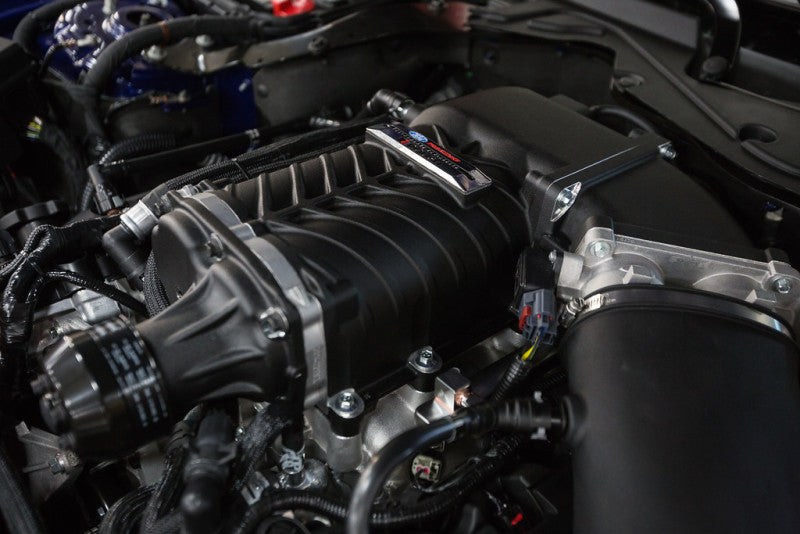
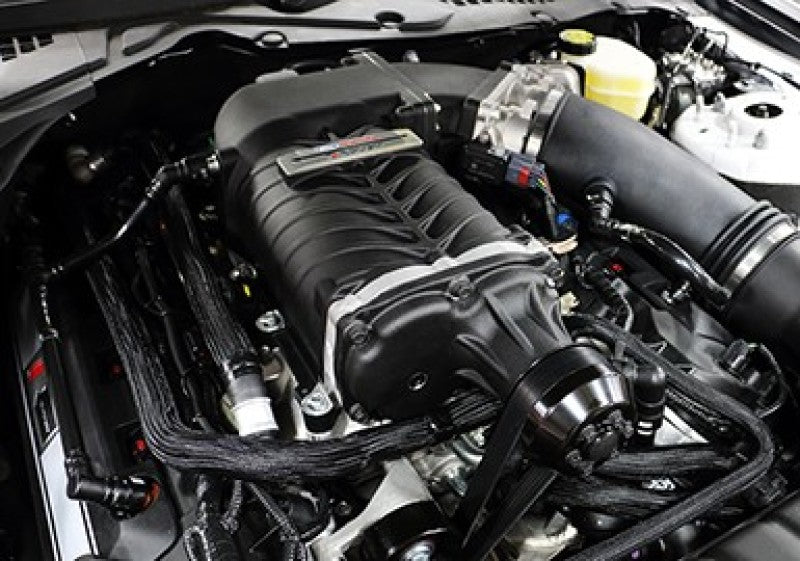
Which Mustang supercharger fits your engine?
Supercharger fitment is engine-specific. A kit built for the 5.0L Coyote will not fit the 2.3L EcoBoost, and vice versa. Always confirm by year, engine, and generation before ordering.
| Mustang engine | What you'll find in this collection |
|---|
| 2.3L EcoBoost (2015-2023) | Boost hardware, upgraded intercoolers, and supporting mods. Fitment differs between 2015-2017 and 2018-2023, so check the product listing for your exact year. |
| 5.0L Coyote GT / Mach 1 (2015-2023) | Twin-screw, roots-style, and centrifugal supercharger kits, plus pulleys and intercoolers. Gen 3 and Gen 4 Coyote can have different part numbers; Mach 1 shares the GT architecture but may have hood-clearance considerations. |
GT500 owners running the factory 5.2L Predator are looking at pulley and blower upgrades rather than full kit installs. For S650 (2024+) fitment, the catalog is growing but always verify compatibility in the product listing. Always confirm EU-spec fitment in the product description or contact us before ordering, as compatibility can vary by generation and market-specific components.
What power gain can you realistically expect?
On a stock 2015-2023 Mustang GT 5.0L Coyote, a twin-screw supercharger running 8. 9 psi on a conservative street tune can add roughly 100. 150 whp depending on kit, fuel, and tune. Step up to a more aggressive pulley at 10. 12+ psi and gains beyond 200 whp are possible on well-supported builds, but that requires fuel system and ignition upgrades to support it safely. The low-end torque improvement is noticeable, with stronger pull from low RPM compared to naturally aspirated.
EcoBoost power gains depend on the hardware used and what the factory turbo can support. A well-matched boost upgrade with proper supporting mods can deliver a meaningful bump in mid-range torque and top-end power. Existing bolt-ons like a cold air intake and exhaust help but do not replace a proper tune.
Every Mustang supercharger installation requires an ECU calibration. None of these kits are plug-and-play on the factory map, and running boost without a correct tune risks detonation and engine damage. US kits are typically calibrated for 93 octane. In Europe, 98 RON is the safer daily choice for a boosted Coyote. Running 95 RON E10 is possible on conservative timing and boost, but 98 RON gives you more knock resistance and a better safety margin.
Twin-screw, roots, or centrifugal: which type suits your Mustang?
You are mostly choosing between positive-displacement blowers (twin-screw and roots) and centrifugal systems.
A twin-screw supercharger builds full boost from low RPM and delivers strong torque across the entire rev range. It is the better choice for a daily-driven or mixed-use Mustang where you want on-demand pull in traffic and on the highway. Trade-offs: higher kit price, more under-hood heat, and a distinct mechanical whine that is most audible under hard acceleration. For most buyers, that whine is part of the appeal.
A roots-style supercharger behaves similarly, with a broad torque curve and classic blower character. Often packaged in an OEM-style manifold for a clean install. Sound and heat management are the same considerations as with a twin-screw.
A centrifugal supercharger builds boost progressively with engine speed. It makes the most power at high RPM and suits track-focused builds that spend time in the upper rev range. The trade-off is less low-RPM torque compared to a positive-displacement blower, so daily driving feels less dramatic below 4,000 rpm.
What supporting mods do you need before you boost?
These are commonly recommended alongside a supercharger install. On a supercharged Mustang, the following are often required to safely run the advertised boost level:
- Colder-range spark plugs: Many boosted Coyotes and EcoBoosts typically use colder-range plugs to reduce knock and misfire risk. The colder-range spark plugs for boosted Mustang builds are a straightforward starting point. They require slightly more frequent replacement than stock plugs.
- Cold air intake (EcoBoost): A well-designed intake supports airflow and gives the tune more to work with. For 2015-2017 EcoBoost Mustangs, the Roush cold air kit for 2015-2017 EcoBoost Mustang is a direct fit, confirm fitment in the product listing for your exact year. For 2018-2023, use the Roush cold air kit for 2018-2023 EcoBoost Mustang. again, verify your year in the product listing. Intake noise increases slightly; filter maintenance applies.
- Fuel system: At higher boost levels, the factory fuel pump and injectors can become limiting factors. Browse fuel system upgrades for supercharged Mustang for pump and injector options. Added cost, but essential for engine safety above entry-level boost.
- Ignition and ECU tuning: A correct calibration is non-negotiable. See ignition components for boosted builds and ECU tuning and calibration tools for what you need alongside the hardware.
- Exhaust (EcoBoost): Freeing up the exhaust helps spool and keeps exhaust gas temperatures in check. The MBRP axle-back exhaust for boosted EcoBoost Mustang is a direct bolt-on for EcoBoost Mustangs. confirm your exact year in the product listing. It is louder than stock; not a stealth setup.
- Intercooler and cooling: For sustained track use, an intercooler or heat exchanger upgrade keeps charge temperatures in check and protects your gains lap after lap.
Most complete supercharger kits are designed to accept larger intercoolers, more aggressive pulleys, and upgraded fuel components later. You are building a platform, not hitting a ceiling.
FAQ
Does the kit include a tune?
Some kits ship with a base calibration or tune credit; others are hardware-only. Always check the kit contents list before comparing prices. If a tune is not included, budget time and cost for a custom dyno tune or a remote calibration from a Mustang specialist.
Can I run a supercharged Mustang on 95 RON E10 in Europe?
On a conservative boost and timing map, yes. But 98 RON gives more knock resistance and a better safety margin, and it is what we recommend for everyday use on a boosted Coyote. Running 95 RON E10 long-term on an aggressive tune is a risk we would not take.
Is the kit bolt-on or does it require cutting or welding?
Many listed Mustang supercharger systems are bolt-on within the engine bay. No chassis fabrication required, but you will remove factory components, route new belts and lines, and spend a full day or more on the install. It is not a quick afternoon job.
Will the supercharger fit my EU-spec left-hand-drive Mustang?
Always verify fitment for your specific model year and trim in the product description. If you are unsure, contact us before ordering.
How long does installation typically take?
Installation time varies by kit, skill level, and supporting modifications. Plan for a substantial time commitment for a careful DIY install with proper tools and a lift, plus additional time for the tune. If major engine work is not something you do regularly, working with a specialist shop is the safer call.
What warranty and support applies?
Hardware warranty is brand-specific and listed on each product page. Tuningsupply handles EU-based shipping, returns, and fitment questions, keeping the process straightforward for European customers.